
The History of Oettingen
The first written mention of Oettingen dates back to the 9th century. Since 1141, the place has been the seat of the Counts and later Princes of Oettingen. They expanded their centre of power and established a market settlement next to the castle. By the 13th century, the town was walled, and to this day, the city wall remains largely intact – although without a walkway.
The past as the capital and residence of an independent state continues to shape the town today. Since the early 15th century, Oettingen was even divided between two ruling lines. When the Oettingen-Oettingen line joined the Reformation in 1539, the territorial division was further deepened by confessional differences.
As a bi-confessional residence town, Oettingen developed its historical uniqueness (visible in a dedicated section of the local museum). St. Jakob became the Protestant parish church, and the Latin school founded in 1563 (now Albrecht-Ernst-Gymnasium) trained local youth for the Oettingen regional church and the princely court. The original pilgrimage church of St. Sebastian became a Catholic parish church. The parish was managed by Jesuits from 1641 to 1782, who also brought the Sebastian pilgrimage to great prominence at times.
Alongside the Christian communities, Jews have been settled here since the Middle Ages. Since the 17th century, the Oettingen Jewish community steadily grew, and the town was the seat of a rabbinical authority. The Jewish cemetery (1851) is located in the northern part of the town.
The townscape is characterised by the construction activities of the Baroque period. As a princely residence town, it had numerous representative buildings, including two palaces and several central facilities.
With the mediatisation in 1806, Oettingen lost its status as the capital of its own principality and was incorporated into the Kingdom of Bavaria.
Economically, the town remained shaped by craftsmanship and its central importance for the surrounding area for centuries. Despite the early railway connection in 1849, only one truly large enterprise developed before the Second World War: The organ-building company Steinmeyer, whose instruments were delivered worldwide.
In the meantime, significant changes have occurred with the settlement of commercial enterprises and the establishment of extensive building areas. Thanks to the incorporation of new districts and the establishment of the Oettingen administrative community, the town has maintained its significance as an administrative centre. With the local museum, the adult education centre, residence concerts, and much more, the town of Oettingen offers an impressive cultural programme.
The "Krone"
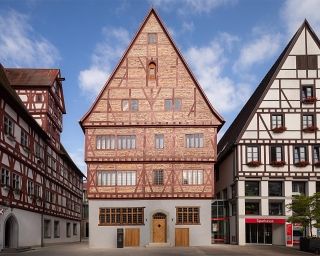
In the heart of the town, at the marketplace, lies the impressive half-timbered building of the "Krone". It dates back to the first third of the 15th century: Dendrochronological examinations of the beams of the roof structure date it to the year 1424/25. The Krone is thus older than the town hall, the construction of which evidently only began after the completion of the neighbouring building, the Krone. The attic served for storage, and the three spacious fruit lofts provided ample space. Today, the construction of the collar beam roof with double-lying struts is an architectural rarity and of great value to building researchers.
Presumably, the house was originally an inn. The owners can only be documented in writing since 1548, but without gaps. The establishment had the right to serve wine and brew beer during the times of the counts and princes. Two wine cellars and a beer cellar already belonged to the property centuries ago. Additionally, there were spacious stables for cattle and horse stables for 50 horses. The Krone was still the popular accommodation for outside guests and higher-ranking visitors in the 18th century. Noble events such as balls, theatre performances, and concerts also took place here.
From 1886 to 1924, the property belonged to the princely house. The princely brewery administration had a bowling alley and a hall built in the Krone garden. The garden itself was laid out around 1800 after part of the wet ditch was filled in. The Krone establishment was operated by tenants who frequently changed.
This remained the case when the town of Oettingen purchased the property in 1924. The town then had the still-existing Krone hall (partially incorporating the predecessor building) built in 1928. It is also an architectural rarity: Its free-standing ceiling was constructed in the so-called "Zollinger" method, a special diamond-lattice construction. Around the time of the construction of the new Krone hall, the intermediate building between the hall and the establishment – which no longer exists today – was also structurally altered and converted into the municipal vocational school; various school classes were housed here until the 1970s. The town continued to operate the inn through tenants, but more and more tenants were also accommodated in the building, until in 1954 the ground floor was repurposed: A notary moved in. The inn was closed.
In the 1970s, a structural modernisation of the entire complex took place, including the now unused school, and in 1977 the current Hotel Krone was opened. Leased to the Paulaner Brewery and operated by their respective "sub-tenants", these changed at increasingly shorter intervals. In 1999, the Seebauer family took over the hotel and acquired the property in 2003. In 2017, a "usage prohibition" was issued due to the identified severe deformations of the roof structure, and emergency measures were taken. In 2020, the town of Oettingen reacquired the property and developed a new usage concept. The Krone was then included as a national project of urban development in a nationwide funding programme and was converted into a hotel, incorporating the former intermediate building and other former barns at the city wall.